
Operational Advantage Architecture (OAA)
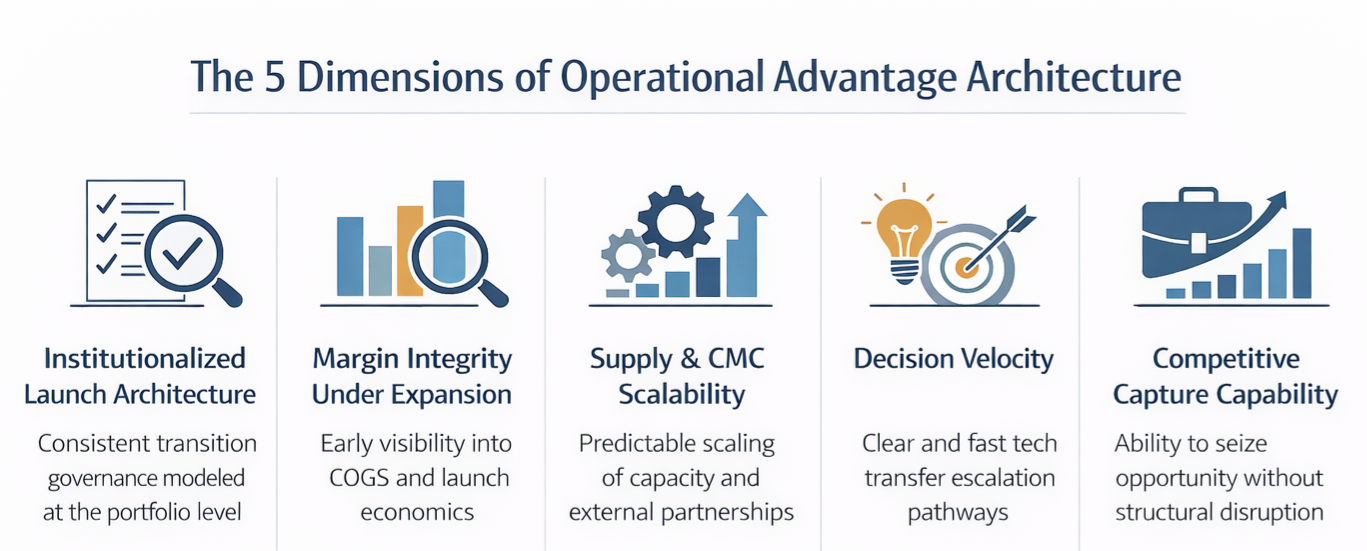
Institutionalizing scalable launch capability under pipeline expansion
In regulated, high-consequence environments, early launch success often proves scientific capability. As pipelines expand, the structural test becomes whether launch capability is enterprise-institutionalized or remains program-dependent.
Schedule an Executive Conversation Learn How OAA Can Be Applied
In a brief conversation, we’ll clarify your pipeline context and determine whether an OAA executive session would be useful.
What OAA is
OAA is a structured executive framework to assess whether operating architecture can absorb sequential and concurrent pipeline complexity without predictable breakdowns in timing, margin, supply reliability, or decision velocity.
- Focused Diagnostic Review
- Architecture-level lens—above individual initiatives or isolated improvements
- Designed to surface structural constraints before they become expensive
OAA is not Lean training, not a VSM extension, and not a packaged “program.” It is a disciplined way to align leadership on architectural reality and scaling requirements.
Where OAA applies
OAA is designed for executive and senior leadership teams responsible for scaling launch capability in regulated, pipeline-driven environments.
- Intended audience: executive leadership, operations leadership, and cross-functional decision-makers
- Scope: the operating architecture spanning R&D, tech transfer, manufacturing, supply chain, and commercialization readiness
- Primary purpose: identify whether launch capability is enterprise-institutionalized or still dependent on individual programs, leaders, or workarounds
OAA is not intended to impose a framework on the organization. It is intended to help leadership identify structural gaps, clarify architectural readiness, and determine what institutionalization may require as pipeline complexity increases.
In biotech and med device environments, architectural strain often increases when organizations move across modalities, manufacturing models, or supply configurations. What works for a small molecule program may not translate cleanly to biologics, cell therapy, combination products, or other emerging platforms. OAA is designed to help leadership determine whether operating architecture can adapt to that complexity before commercialization pressure makes the gaps visible.
OAA: Operational Advantage Architecture
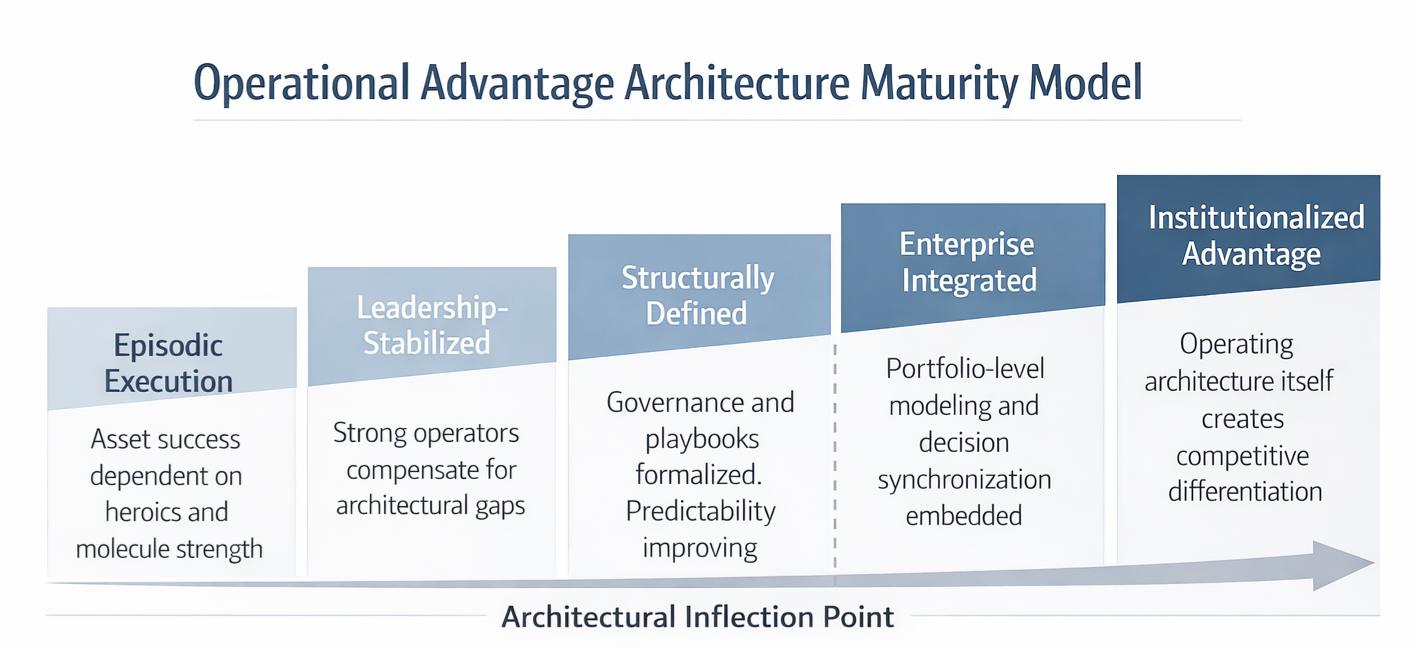
Maturity model
OAA uses a five-level maturity model to determine whether launch capability scales with pipeline complexity and where the Architectural Inflection Point occurs.
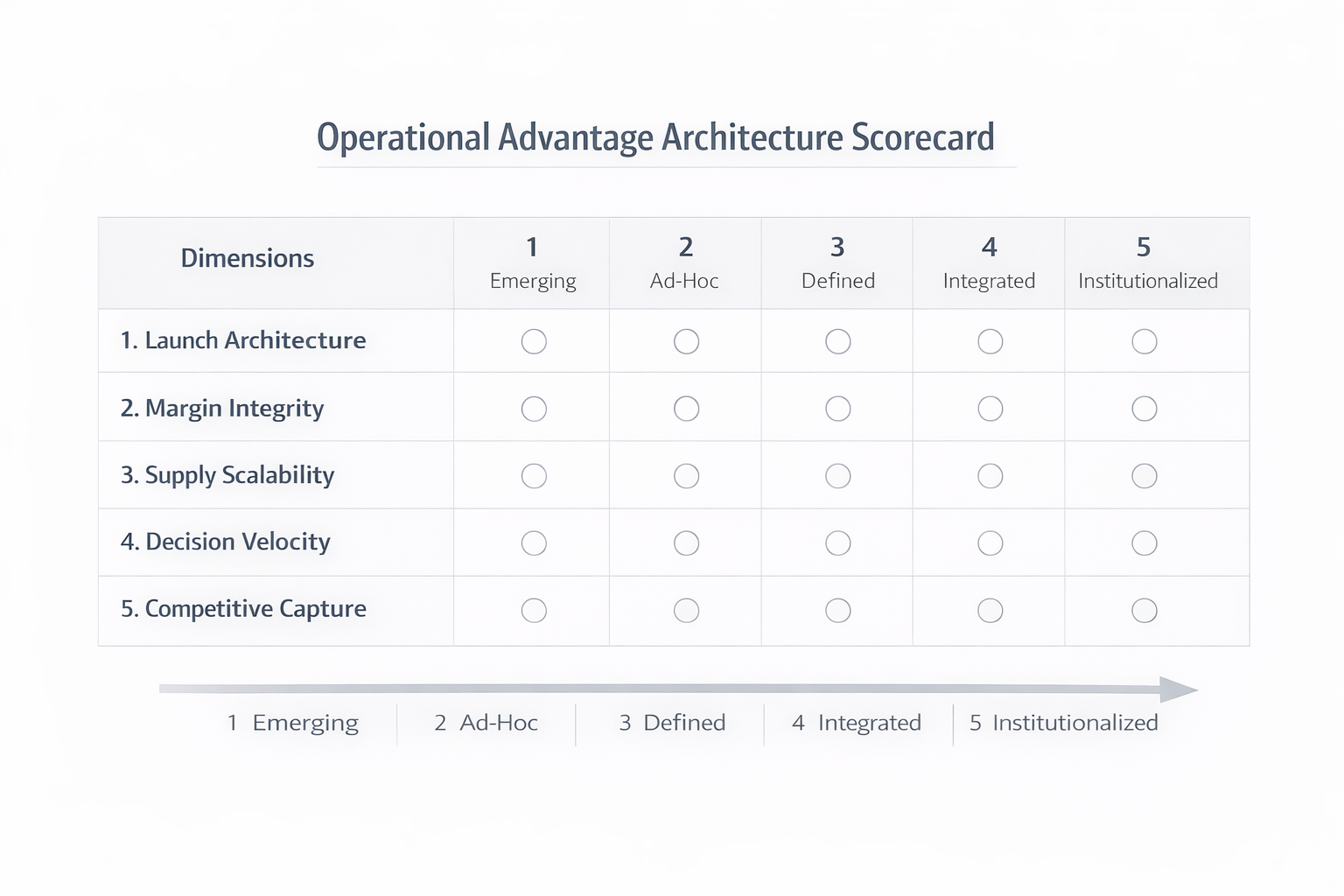
Scorecard
A simple executive scorecard is used live to capture consensus, divergence, and the structural constraints most likely to bind under expansion.
How OAA Can be Applied
1. Executive Diagnostic Session. A structured, live executive discussion designed to assess whether operating architecture can absorb pipeline expansion without predictable breakdowns in timing, margin, supply reliability, or decision velocity.
- Position the organization on the architectural maturity model
- Score the five structural dimensions in real time
- Surface alignment and divergence across leadership
- Identify the constraint most likely to bind under expansion
- Clarify next-step options without presupposing an initiative
The session is facilitated live — not distributed as a survey — and requires no preparation in advance.
2. Focused Diagnostic Review. A more substantive first step used when the organization already knows deeper assessment is likely needed. This may include targeted leadership interviews, review of relevant current-state materials, and a concise leadership synthesis on where capability appears institutionalized, where it remains too program-dependent, and what next step would be most useful.
What OAA is not
- A Lean training program
- A diagnostic survey sent for completion
- A packaged transformation “journey”
- A replacement for internal leadership ownership
OAA is designed to strengthen leadership clarity and reveal what institutionalization requires—before scaling pressure makes the cost visible.
Next step
The appropriate next step is a short executive conversation to determine whether an OAA Diagnostic or Executive Session would be useful given your objectives and context.
To return to our Services page, click here.